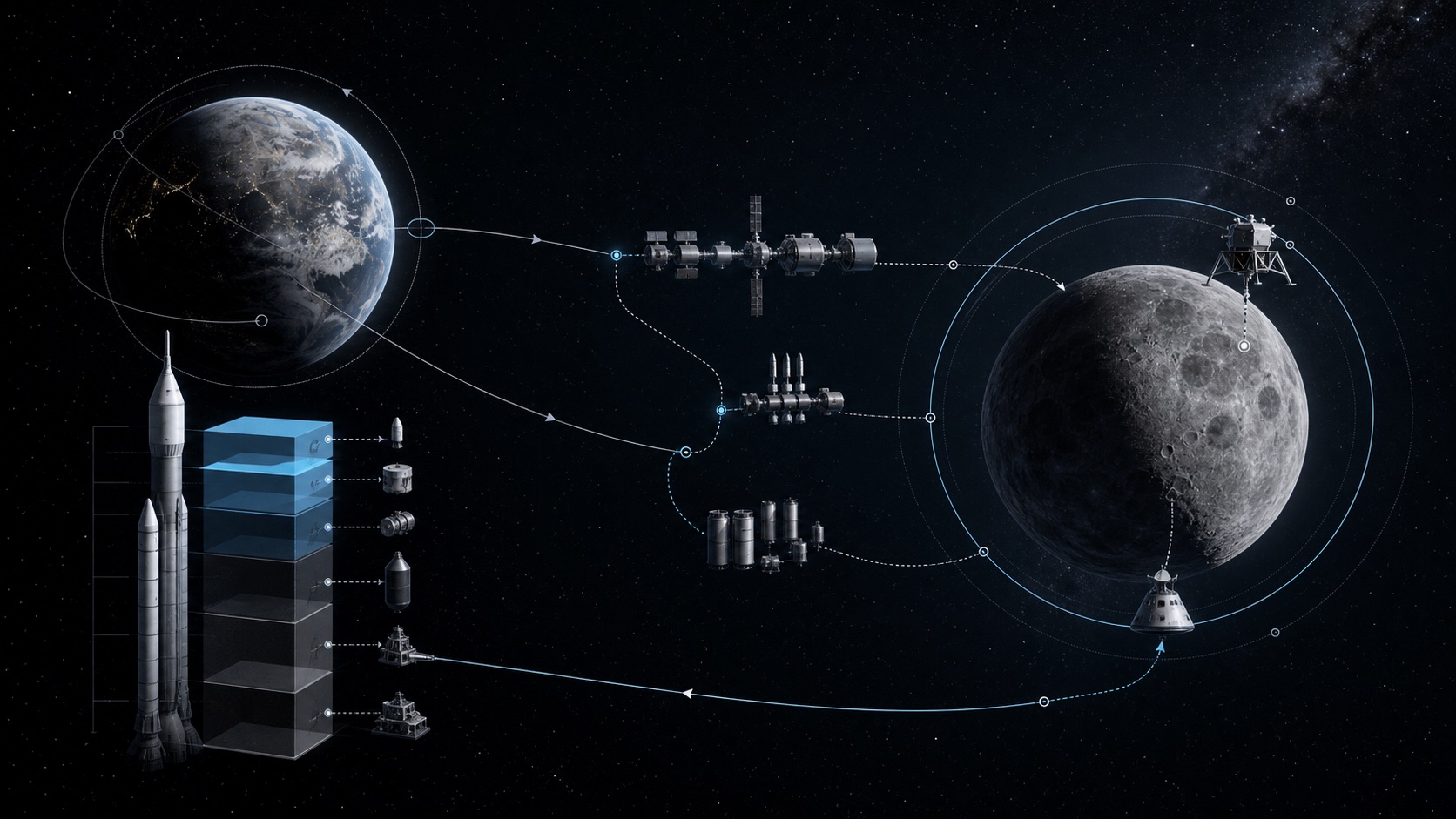
Current route
Personal satellite: verified LEO message.
CosmosExplore now maps a practical first arc: define a small payload, reach low Earth orbit through compliant hosted or rideshare paths, receive a verified message on the ground, and keep safety, spectrum, debris, and non-commercial boundaries visible.
What changed
The Moon remains the long arc. LEO is the first accountable milestone.
The original CosmosExplore question was lunar access: which costs, logistics, and risks make the Moon behave like national infrastructure? That question remains. The near-term practical path is now smaller and more inspectable.
The first personal milestone is not a private orbital rocket, a commercial communications service, or a passenger route. It is an uncrewed learning mission: a compliant small payload or satellite that can send one authenticated, logged, verifiable message from low Earth orbit.
That reframes the project into four problems: transmission, access to orbit, sustainment, and control or recovery. Every public page should keep those problems separate from authorization, safety, and operating claims.
First four problems
The path is a boundary graph, not a parts list.
Operating boundary
The current public scope stays personal, non-commercial, and source-backed.
- No commercial communications, remote-sensing service, launch service, or funding story is implied.
- No frequency, power, antenna, modulation, command, attitude-control, propulsion, or launch-operation recipe is published.
- Regulatory nodes point to official sources and review dates; they are not legal advice or authorization.
- Planner v0 is intentionally absent until OPUS reviews a deterministic registry lookup design.
First milestoneLEO messageverified, logged
New nodes33personal satellite first wave
Registries3mission / regulatory / safety