Put the glass down
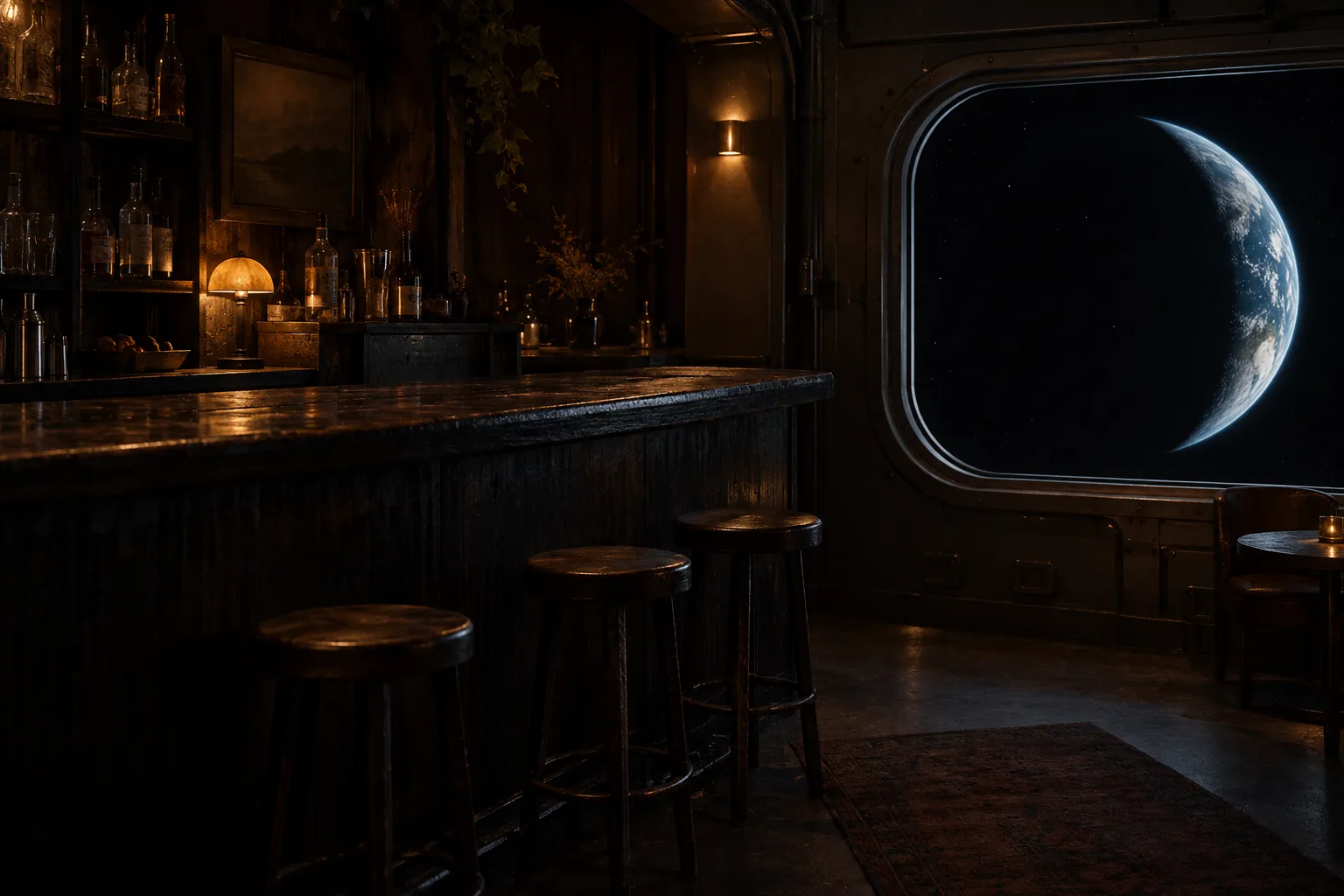
At Sunstray’s third-ring bar, an ordinary thing provides the first relief: a glass can stay on the counter by itself. This local area is close to 1g. Let go, and the drink remains where you left it. Your other hand is free to turn a page, or do nothing.
Travel often asks the body to stay alert: secure an object, find a direction, wait for the next door. The bar offers familiar movements. Sit down. Move a glass aside. Make room for someone else. They are too small for a journey record, yet they make an unfamiliar place inhabitable.
Under the lamp, the wood looks warmer than the view beyond it. Being in orbit has not spared it wear, glass rings or corners that need wiping. People still wet their cuffs, hesitate over another drink and discover they have stopped checking the time.
A window you can ignore
Earth fills part of the window, its boundary between light and darkness slowly changing. A first-time visitor may turn a chair towards the glass. After a while, attention returns to the table. The view has not become smaller. It simply no longer asks to be admired every second.
This casualness matters. A place that can only be photographed is still a destination. When someone is willing to sit with their back to the window, it begins to become a place to live. Part of a bar’s appeal is permission to lose interest in the spectacular.
When someone sits with their back to Earth, the room begins to become a place to live.
The window supplies one rhythm; conversation supplies another. The next stage of a journey can be discussed later. Silence needs no device to fill it.
A tag keeps a little room for the future
The public shelf record uses tag codes. Dates are visible; names are absent. The oldest retained tag is dated 3 November 2119. That is the date on the tag. The record does not tell us what remains inside the bottle or who has custody of it today.
A tag makes a return imaginable. Someone once set something down here and left a small matter for the future. For a passer-by, that can be enough of the story. We need no name to understand why a person might want to enter the same bar again.
Some of the warmth of a public place comes from restraint. One person keeps their private past; another occupies a chair in the present. They can share a room without becoming exhibits for one another.
Leave something behind
The glass will be collected, the counter wiped and the boundary of daylight outside will move on. What a traveller carries away may be less a panorama of Earth than the resistance of wood beneath a palm.
Orbital culture takes shape in small practices: how to sit, how not to pry, how to let a traveller briefly forget the journey. Technology makes the room possible. Living in it makes it worth returning to.