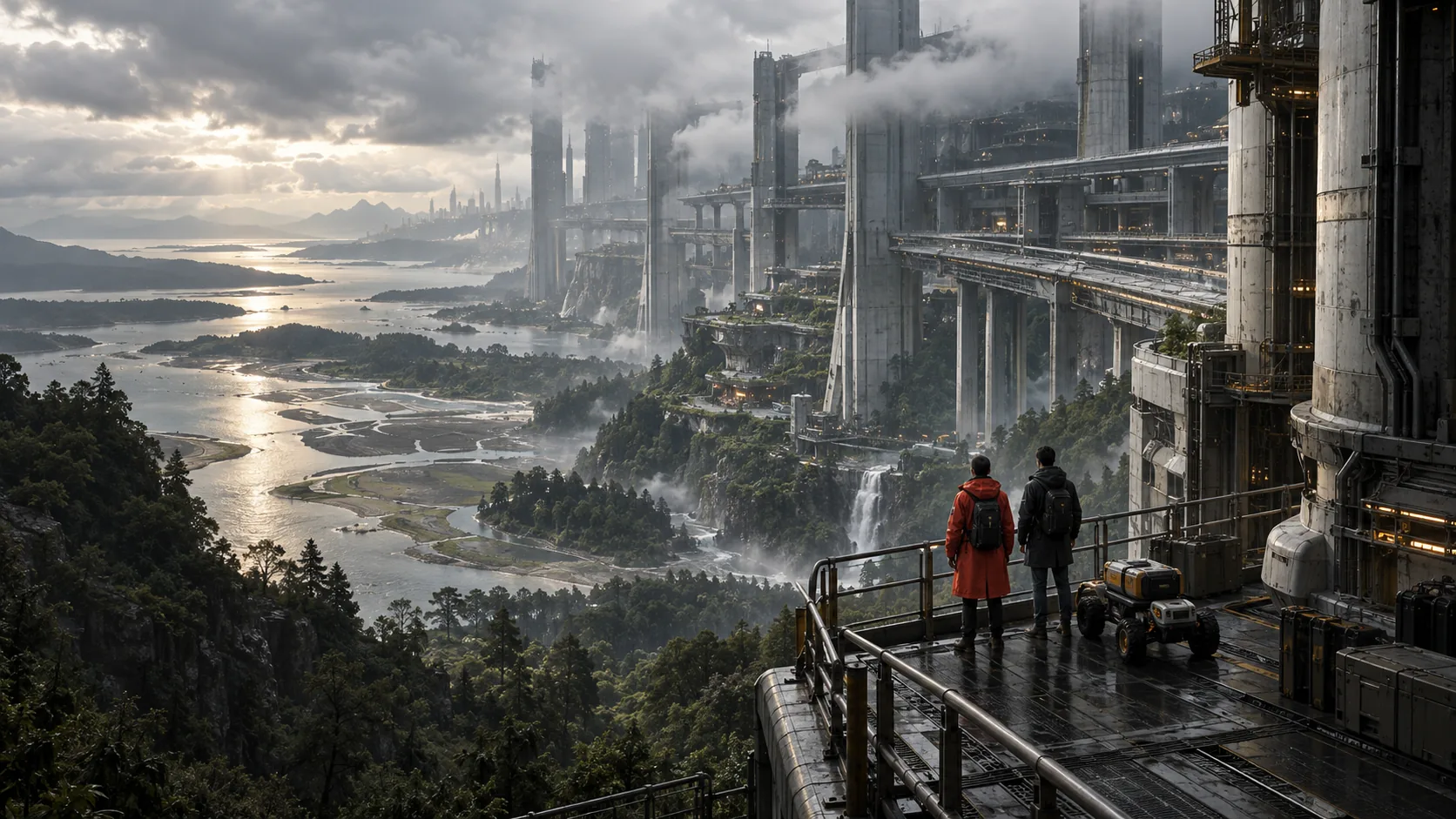
From floors to ground
A route inside the city always has another segment: a lift, a connecting passage, a door that will open. An address tells you to go up or down. A screen turns the distance into minutes. Beyond the city, a bend in the river looks close and takes a long time to reach.
The error puts the body back to work. A slope enters the calves; a headwind enters the breath. Walking becomes more than an interval before arrival. Light, terrain and tiredness help you judge how much farther to go.
The tops of megastructures can rise above the clouds. They create a scale like mountains while remaining cities on the ground. Orbital factories, computing facilities and residential modules belong to another journey. A high window does not turn the two into a continuous corridor.
The sky becomes more than a background
In a life stacked into floors, some weather arrives through windows, roofs and forecasts. Beyond shelter, air reaches the skin first. Rain changes where the next foot can land. Knowing the conditions becomes experiencing them.
This changes the appeal of travel too. Some people want a spectacular landscape. Others want to finish a meal somewhere without a roof. Future travel has room for the latter: a small wish requiring no feat of endurance to justify it.
The first thing distance changes may be the way we estimate a walk.
The city conceals many uncertainties inside systems. Outside, they become tangible again: water on the path, fading light, the energy you must keep for the return.
Open space is already occupied
Large areas of land between cities, and much of the ocean, are reserves. The pale spaces on a map still contain watersheds, habitats, maintenance areas and conditions of access. An unoccupied patch of grass is not necessarily waiting for someone to claim it.
Reserve 9 makes this concrete. After the workshops were dismantled, a maintenance corridor remained. A traveller sees a route. A maintenance worker sees a way to reach a job. The wet ground beside it has to accommodate a boundary. These uses coexist.
“Nature has returned” fits beneath a photograph. A visit supplies more questions: where does water run, who checks the walls, when should a person stop walking? Travel includes accepting that some places are best seen from a distance.
Bring another scale home
Back in the megastructure, floors and transfers divide the journey once more. The experience outside does not disappear. Perhaps you look at a cloud for longer, or leave part of a day free from the need to arrive.
This issue begins with that change. We revisit retired workshops, sit at an orbital bar and look through glass into a closed experiment. The places are far apart. Each brings a question closer: as technology rearranges the world, how do people find a scale for living in it?